We cross from growing life to speeding up chemistry. It buys the most durable storage in the series — and, for the first time, an MRV problem that starts to look solvable.
Part 5 of 7
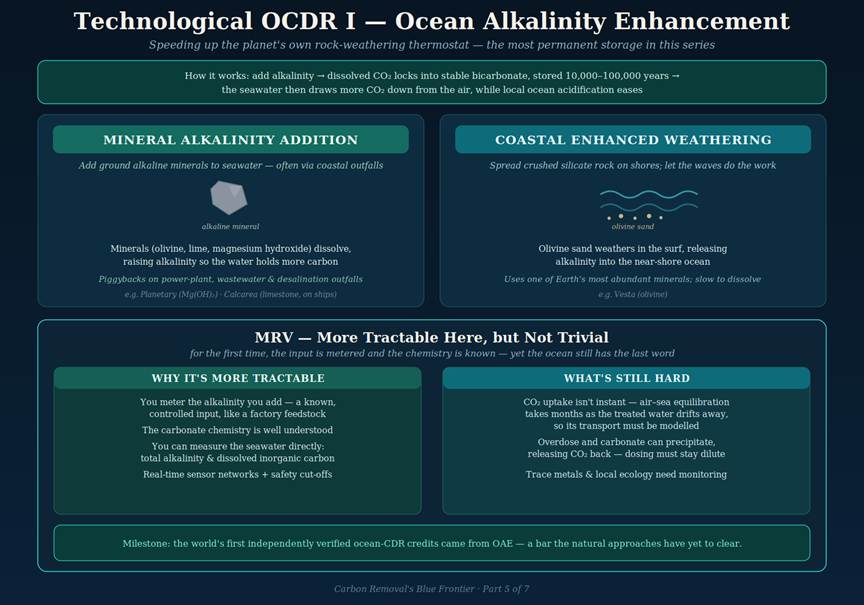
The first four parts stayed in the ocean’s living engine — restoring, growing, and feeding the organisms that pull carbon down. Now we cross into the Technological category, where the logic flips. Instead of coaxing biology, these approaches accelerate the ocean’s own chemistry and physics — the slow, planetary machinery that has regulated atmospheric CO₂ for hundreds of millions of years. The first and most mature of them is Ocean Alkalinity Enhancement, or OAE. And it is where the measurement problem that haunted the natural approaches finally begins to loosen its grip.
The chemistry: rebuilding the ocean’s buffer
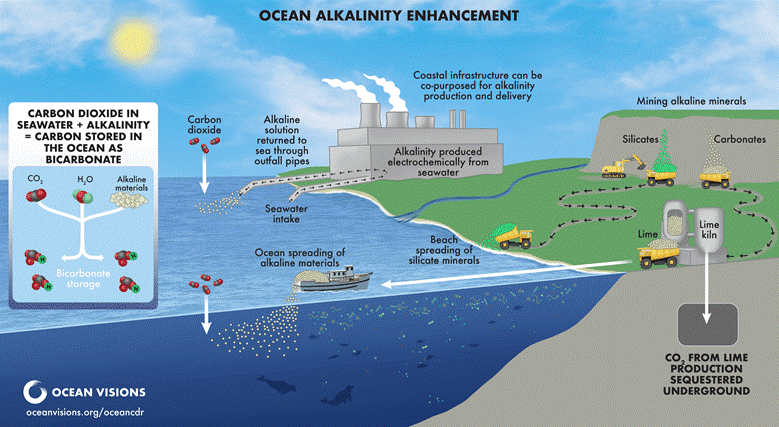
Ocean alkalinity enhancement — adding alkaline minerals to seawater to lock CO₂ away as bicarbonate.
Start with why the ocean can absorb CO₂ at all. When carbon dioxide dissolves in seawater it forms carbonic acid, nudging the water more acidic and — crucially — using up the water’s alkalinity, its built-in capacity to neutralize acid. As alkalinity is consumed, the ocean’s appetite for further CO₂ falls, and its pH drops. That falling pH is the very ocean acidification now threatening corals and shellfish.
OAE attacks both problems with a single move: add alkalinity back. Introduce an alkaline substance to seawater and it neutralizes the acid, converting dissolved CO₂ into bicarbonate — a stable, dissolved form of carbon. Two things follow. First, with its buffer restored, the water draws down more CO₂ from the atmosphere to re-establish equilibrium. Second, acidification eases. One intervention, two benefits.
This isn’t a new trick invented in a lab — it is a shortcut through a process the Earth already runs. Over geologic time, rain and CO₂ slowly weather silicate and carbonate rocks on land; rivers carry the released alkalinity to the sea, where carbon is locked away as bicarbonate for tens of thousands of years. This “weathering thermostat” is one of the planet’s master controls on climate — but it operates over millennia. OAE simply speeds it up to a timescale that matters to us.
The headline benefit: permanence
That geologic pedigree buys the single most important property in the whole series. Carbon stored as bicarbonate in seawater stays put for 10,000 to 100,000 years — orders of magnitude longer than a mangrove’s soil or a sunk bale of seaweed, and with none of their reversal risk. Where the natural approaches trade permanence for low cost and co-benefits, OAE offers durability on a geologic scale. In a field where “how long does it stay down?” is a first-order question, that is a decisive advantage.
The routes: minerals in, two ways
OAE comes in two mineral-based flavors (a third, electrochemical route is the subject of the next part).
The first is direct mineral addition to seawater. Grind an alkaline mineral — olivine and other silicates, lime and other carbonates, or magnesium hydroxide — and dose it into the water. The smartest deployments piggyback on infrastructure that already moves enormous volumes of seawater: the outfalls of power plants, wastewater treatment works, and desalination plants, where the alkalinity disperses and mixes without building anything new. (Planetary Technologies, for instance, doses magnesium hydroxide through coastal outfalls; Calcarea dissolves limestone to treat the exhaust of cargo ships.)
The second is coastal enhanced weathering: spread crushed silicate rock — typically olivine — across beaches and shallow shorelines, and let the waves and tides do the grinding and dissolving that would otherwise take geologic time. It needs no reactors, only one of the most abundant minerals on Earth, though the dissolution is slow and depends heavily on grain size and wave energy. (Vesta is the best-known olivine developer.)
The real constraints
OAE’s problems are not chemistry but scale and side-effects. Removing carbon at gigatonne scale means mining, grinding, and shipping billions of tonnes of rock — an industrial footprint with its own energy cost and land impact. Grinding rock fine enough to dissolve is energy-intensive. Add alkalinity too fast or too concentrated and you can trigger the opposite of the intended reaction — carbonate precipitation, which releases CO₂ back — so dosing must stay dilute and carefully controlled. Some feedstocks, olivine especially, carry trace metals like nickel and chromium that raise ecological questions. And communities are watching: a planned 2025 UK coastal trial was canceled after local opposition, a reminder that public license is as real a constraint as any chemical one.
MRV: the problem finally gets more tractable
Every prior part ended at the same wall — MRV so hard that credits had to be heavily discounted or couldn’t be credibly issued at all. OAE is where that wall starts to come down, for three concrete reasons.
You control and meter the input. Unlike a diffuse bloom drifting across open water, the alkalinity you add is a known, measured quantity — a feedstock you weigh going in, the way a factory meters its inputs. The chemistry is well understood. The carbonate system is one of the most thoroughly characterized in ocean science, so a given amount of added alkalinity has a calculable CO₂-uptake potential. You can measure the seawater directly. The two master variables — total alkalinity and dissolved inorganic carbon — are measurable with established methods and increasingly with in-situ sensors, and because deployments cluster around fixed outfalls, they can be wrapped in real-time sensor networks with automatic safety cut-offs that pause dosing if conditions drift. The proof that this adds up: OAE has produced the world’s first independently verified ocean-CDR credits — a threshold none of the natural approaches has yet crossed.
None of which makes it trivial. The catch is timing and motion. Raising alkalinity doesn’t pull CO₂ from the air instantly; the treated water has to equilibrate with the atmosphere, a process that unfolds over weeks to months — by which point that water has drifted away on currents. So verifying the actual atmospheric removal still requires modeling the transport and equilibration of the treated water, not just sampling it at the pipe. You must also confirm no counterproductive precipitation occurred, and keep monitoring trace metals and local ecology. OAE MRV, in short, is a metered input plus direct local chemistry plus a transport model — far more grounded than anything in the natural category, but still leaning on models for the final, atmosphere-side tonne.
Reading the scorecard
Against the Part 2 lens, OAE is the strong all-rounder of ocean carbon removal: best-in-class durability (geologic-scale storage), high scalability with a credible path toward the sub-$100-per-tonne range, a genuine co-benefit in reversing acidification, and — the breakthrough — MRV tractable enough to yield verified credits. Its costs are a real mining-and-energy footprint and a set of ecological and social guardrails that must be respected. It is, on balance, the most investable corner of the map we’ve reached so far.
And it’s about to get even more factory-like. In the next part, we swap minerals for electricity — using electrochemistry to pull the same chemistry off, with the most meterable, plant-like process in the entire field.
Next in the series — Part 6: Technological OCDR II — Electrochemical Carbon Removal & Direct Ocean Capture. Splitting seawater with electricity to strip out CO₂ or bank alkalinity — the most controllable, and most energy-hungry, approach of all.
Leave a Reply