Out in open water the removal engine shrinks to the microscopic — and becomes the single hardest thing in the field to prove.
Part 4 of 7
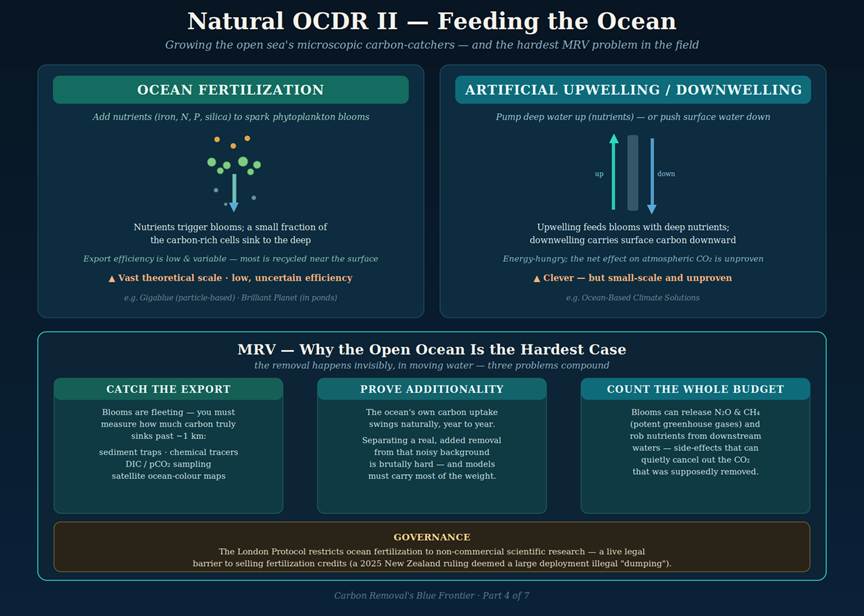
In Part 3, we stayed at the coast, where you can core a marsh and sample what it stores. Now we head into open water, where the same biological pump runs on a very different engine: phytoplankton — microscopic drifting plants that carry out roughly half of all photosynthesis on Earth. The removal principle is unchanged; only the scale of the organism, and the difficulty of measurement, have flipped. There are two ways to grow more phytoplankton: bring nutrients to them (fertilization), or bring them to the nutrients (artificial upwelling). Both are conceptually elegant. Both are, in practice, the hardest members of the whole OCDR category to verify.
Ocean fertilization: engineering a bloom
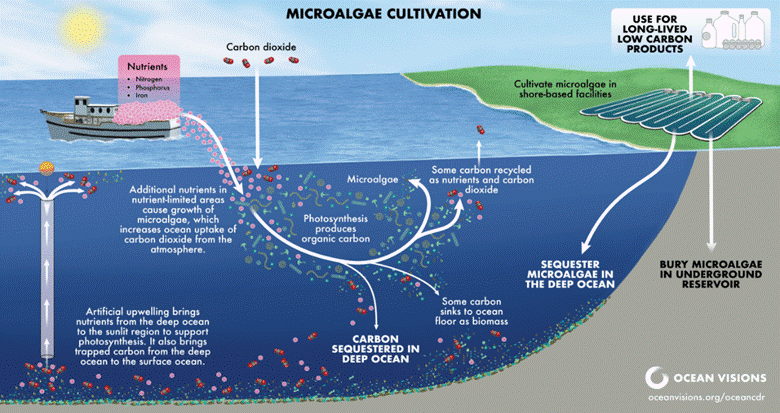
Microalgae (phytoplankton) cultivation and ocean fertilization — growing the sea’s microscopic carbon-catchers.
Phytoplankton growth is limited not by sunlight or CO₂ but by nutrients. Across roughly a third of the ocean — the vast “high-nutrient, low-chlorophyll” regions — the missing ingredient is iron; elsewhere it’s nitrogen, phosphorus, or silica. The premise of ocean fertilization is simple arithmetic: add the limiting nutrient, trigger a bloom, and let the extra phytoplankton pull dissolved CO₂ out of the surface water. As that water is depleted of CO₂, it draws down more from the atmosphere to rebalance. When the bloom dies, the hope is that a portion of the carbon-rich cells sink below the reach of the surface and are stored in the deep sea.
That last sentence hides the entire problem, and it has a name: the sequestration fraction — the share of bloom carbon that actually reaches durable depth rather than being eaten, respired, and recycled back near the surface within weeks. Decades of open-ocean experiments (more than a dozen deliberate iron-fertilization trials since the 1990s) taught a sobering lesson: blooms are easy to create, but the fraction that sinks deep and stays is usually small, highly variable, and maddeningly hard to measure.
The technology has since branched. One line engineers the sinking itself — coating tailored nutrients onto dense particles designed to grow phytoplankton and then carry them down reliably (the approach of ventures like Gigablue). Another sidesteps the open ocean altogether, cultivating microalgae in contained coastal ponds or photobioreactors (sealed tanks) and burying the biomass on land, trading vast scale for far better control and measurability (as Brilliant Planet does in the desert). The spectrum runs from “nudge a wild ocean” to “farm a contained crop,” and measurability improves as you move toward the controlled end.
Artificial upwelling and downwelling: moving the water itself
If nutrients are the constraint, why import them at all? The deep ocean is already rich in them. Artificial upwelling uses pumps — some designed to run on wave or solar power — to lift cold, nutrient-laden deep water to the sunlit surface, fertilizing blooms with the ocean’s own supply. Its mirror image, artificial downwelling, pushes carbon-rich surface water downward, hastening the sinking branch of the natural pump.
The elegance is real, but so is the catch, and it’s a subtle one. Deep water is nutrient-rich and carbon-rich — it holds a lot of dissolved CO₂. Pump it to the surface and some of that CO₂ can outgas straight back to the atmosphere, partly offsetting the carbon the resulting bloom draws down. Whether the net effect is meaningful removal or an expensive wash is genuinely unsettled, and the approach remains energy-intensive and small in scale.
MRV: why the open ocean is the hardest case
Every part of this series has returned to MRV — Measurement (and ongoing Monitoring), Reporting, and Verification — because it is where ocean carbon removal succeeds or fails. In this category it reaches its most extreme. On the coast the carbon sits still in the soil; here the “removal” is a transient bloom drifting through a moving, three-dimensional fluid, and three problems compound.
First, you have to catch the export. The claim is that carbon sank to durable depth — so you must measure how much actually crossed below the surface layer, roughly a kilometer down. The instruments exist — sediment traps that physically intercept the falling flux, chemical tracers that follow a fertilized water mass, dissolved inorganic carbon and CO₂ pressure (pCO₂) sampling to track uptake, satellite ocean color to size the bloom, autonomous floats — but the flux is patchy, most of it is remineralized (broken back down into CO₂) on the way down, and no instrument captures the whole moving plume. Direct measurement is always partial.
Second, you have to prove additionality against a noisy baseline. The ocean’s natural carbon uptake swings from year to year and place to place. Isolating a deliberate, added removal from that churning background is extraordinarily difficult, which forces the accounting to lean heavily on biogeochemical models — and models of a system this complex carry large error bars.
Third, you have to count the whole greenhouse-gas budget, not just the CO₂. Blooms can generate nitrous oxide and methane — greenhouse gases far more potent, tonne for tonne, than CO₂ — and heavy fertilization can trigger oxygen depletion or shift productivity by “robbing” nutrients that phytoplankton downstream would otherwise have used. A credible removal number has to net all of these side-effects against the CO₂ drawn down. Ignore them and you overcount; include them honestly and the margin can shrink dramatically.
Put together, these three problems mean open-ocean approaches rest on models filling for measurements to a degree no other OCDR category requires — which is exactly why their credits attract the deepest discounts and the loudest scientific skepticism. The measurement problem isn’t a detail here; it is the technology’s central obstacle.
Governance: a defining constraint, not a footnote
For most technologies, regulation is a downstream concern. For open-ocean fertilization it is built into the definition of the approach. Under the London Protocol — the international treaty governing dumping at sea — a 2013 amendment restricts ocean fertilization to legitimate scientific research that yields no commercial gain. That collides head-on with any business built on selling removal credits, and regulators have enforced the line: in 2025, New Zealand authorities concluded that a proposed large-scale particle deployment amounted to illegal “dumping.” For this category, whether an activity even counts as regulated ocean fertilization can decide whether it is legal — making governance as decisive as the science.
Reading the scorecard
Against the Part 2 lens, this category is the high-variance bet: potentially enormous in scale and cheap per tonne if it works, running mostly on natural processes — but scoring poorly on durability certainty, worst-in-class on measurability, and uniquely exposed on governance and ecological risk. It is the corner of the map where the upside is largest and the proof is thinnest.
That thin proof is exactly what the next category sets out to fix. In Part 5 we cross into technological OCDR — where, for the first time, the removal can be metered like a factory, and MRV starts to get easier.
Next in the series — Part 5: Technological OCDR I — Ocean Alkalinity Enhancement. Speeding up the planet’s own weathering to lock carbon into seawater as bicarbonate — and why its MRV, while hard, is more tractable than anything we’ve seen so far.
Leave a Reply