Replace the minerals with electricity, and ocean carbon removal starts to look like a factory — the most controllable and meterable process in the field, and the most power-hungry.
Part 6 of 7
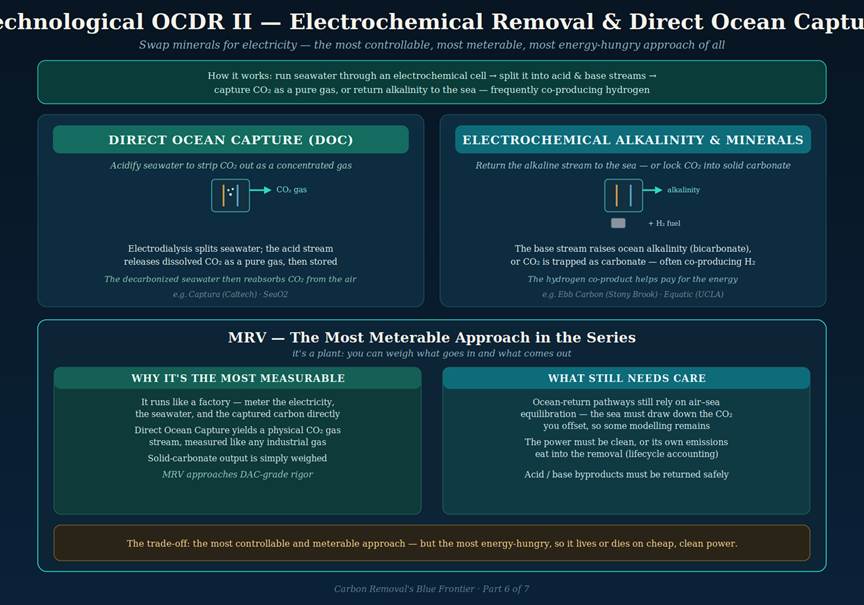
The last post added alkalinity to the sea by dissolving rock. This one does the same chemistry — and more — with electricity. By running seawater through an electrochemical cell, these approaches manipulate ocean chemistry directly, with a dial-like control the mineral methods can’t match. It is the most industrial corner of ocean carbon removal: less “spread a mineral and wait,” more “build a plant and meter the output.” That shift changes almost everything, including the measurement problem that has shadowed every post so far.
The core idea: splitting seawater
Every approach in this post starts from the same move. Pass seawater through a cell and apply electricity, and you can split it into two streams: an acid stream and a base (alkaline) stream. Seawater is full of dissolved salts and carbon, so this separation is straightforward electrochemistry. What you do with those two streams is what divides the field into its two branches.
Branch one: pulling CO₂ out — Direct Ocean Capture
The first branch uses the acid. Take the acidic stream and add it to a slipstream of seawater, and you lower that water’s pH. Remember from Post 5 that most of the ocean’s carbon rides as dissolved bicarbonate; acidify the water and that bicarbonate converts back into CO₂ gas, which can be stripped out as a concentrated stream. This is Direct Ocean Capture (DOC) — and its defining feature is that it produces a real, physical, capturable flow of CO₂, using nothing but seawater and electricity, with no mined minerals or additives.
Two things then happen. The captured CO₂ gas is sent to durable storage (more on that below). And the water left behind — now stripped of its carbon and effectively “thirsty” — is returned to the sea, where it pulls fresh CO₂ down from the atmosphere to refill its deficit. (Captura, a Caltech spinout, and the Dutch company SeaO2 are the best-known DOC developers.)
Branch two: banking alkalinity and minerals
The second branch uses the base. Instead of extracting CO₂, you return the alkaline stream to the ocean — which is simply Post 5’s alkalinity enhancement done electrochemically rather than with rock, raising the water’s buffer so it locks carbon away as bicarbonate. (This is Ebb Carbon’s approach.) A related variant runs the reaction so that CO₂ is trapped as solid carbonate minerals, while the same electrolysis co-produces hydrogen and oxygen. The hydrogen matters: it’s a saleable, carbon-negative fuel whose revenue helps offset the considerable energy the process consumes. (Equatic, spun out of UCLA, pairs mineral-and-dissolved carbon storage with hydrogen production, and is building a commercial-scale plant designed to remove on the order of a hundred thousand tonnes of CO₂ a year.)
Where the carbon goes: deep-sea and sub-seabed storage
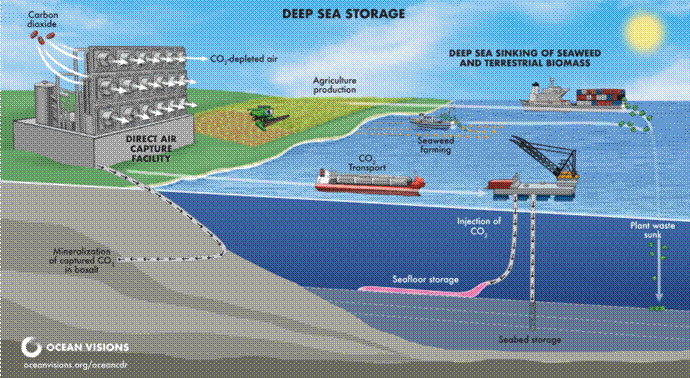
Deep-sea and sub-seabed storage — injecting captured CO₂ into geologic formations beneath the ocean floor.
Direct Ocean Capture hands you a concentrated stream of CO₂, which raises the same question DAC faces: where does it go? The leading answer is geologic storage beneath the seabed — injecting the CO₂ into basalt formations or saline aquifers under the ocean floor, where it mineralizes or is trapped for the long term. A more contested option is deep-ocean storage, releasing CO₂ into the abyss where pressure and cold would hold it, though concerns about local acidification and monitoring make sub-seabed geology the far more accepted route. Either way, storage is governed carefully, and it is an integral part of the removal claim — carbon captured but poorly stored is no removal at all.
The defining trade-off: energy
If OAE’s central constraint was mining, the electrochemical family’s is power. Splitting seawater takes a great deal of electricity, and that single fact drives the whole profile. It means these plants must run on abundant, clean electricity — hydro, nuclear, or surplus renewables — because if the power itself is carbon-intensive, its emissions simply eat the removal. It means siting matters as much as chemistry. And it means economics hinge on both cheap clean power and co-products: the hydrogen from mineralization plants, or the sheer efficiency of a well-designed cell. Costs today are high, but they are falling fast — leading developers now target the sub-$100-per-tonne range this decade, with the most aggressive aiming far lower as their reactors scale.
MRV: the problem all but dissolves
Here the thread that has run through this entire series reaches its resolution. Recall the progression: open-ocean fertilization was nearly impossible to verify; blue carbon was hard; alkalinity enhancement got tractable. Electrochemical removal is the most measurable approach in the field, for a simple reason — it is a plant, and you can meter what goes in and what comes out.
You measure the electricity consumed, the seawater processed, and — crucially — the carbon captured directly. In Direct Ocean Capture, the output is a physical stream of CO₂ gas that can be metered with the same instruments any industrial gas plant uses; in mineralization, the solid carbonate can simply be weighed. There is no drifting bloom to chase, no diffuse plume to model. For these steps, MRV approaches the rigor of Direct Air Capture — which is why this family inspires the most confidence per tonne claimed.
It is not entirely free of the ocean’s complications. The pathways that return water or alkalinity to the sea still depend on air-sea equilibration — the ocean must actually draw down the CO₂ you’ve offset, which takes time and some modelling, just as with OAE. The carbon intensity of the electricity must be accounted for over the full lifecycle, or the removal is overstated. And the acid and base byproducts must be returned to the sea safely, without local chemical shocks. But these are refinements on an approach whose core measurement is, for the first time in this series, essentially a direct one.
Reading the scorecard
Against the Post-2 lens, the electrochemical family is the high-tech end of the map: best-in-class MRV and geologic-scale durability, genuinely modular and scalable, with valuable co-products like hydrogen. Its costs are equally clear — it is the most energy-intensive approach, wholly dependent on cheap clean power, and capital-heavy to build. Where blue carbon was cheap-but-hard-to-verify, this is precisely the opposite: expensive-but-eminently-verifiable. In a market that increasingly pays a premium for certainty, that is a powerful position.
With this post, the map is complete: we’ve walked the Natural family and the Technological family, from a restored mangrove to a seawater electrolyzer. What remains is the question that decides which of these actually scales — not the chemistry, but the capital, the business models, the risks, and the policy. That’s the finale.
Next in the series — Part 7: Following the Money — How OCDR Actually Scales. The capital flooding in, the business models emerging, and the risks and policies that will decide which of these technologies makes it out of the lab.
Leave a Reply