We’ve mapped every technology. But chemistry doesn’t decide what gets built—capital, business models, risk, and policy do. Here’s what the money is telling us.
Part 7 of 7
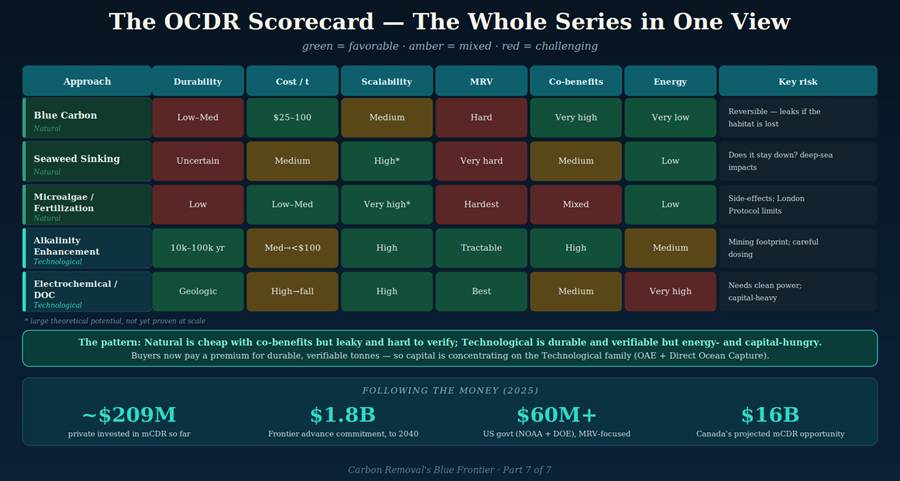
Over six posts, we’ve walked the entire landscape of ocean carbon removal—from a restored mangrove to a seawater electrolyzer, across the Natural and Technological categories. Now we close the series with the question that actually determines which approaches make it out of the pilot stage. It is not which chemistry is most elegant; it is which approach can attract capital, satisfy buyers, survive its risks, and clear regulators. So let’s follow the money.
The whole series in one pattern
Line the approaches up side by side, and a single, clarifying pattern emerges. The Natural family—blue carbon, seaweed, microalgae—is cheap, rich in co-benefits, and gentle on energy, but its storage is leaky and, above all, hard to verify. The Technological category—alkalinity enhancement and electrochemical capture—is the mirror image: storage measured in geologic time and measurement approaching factory-grade rigor, but hungry for energy and capital.
That contrast isn’t just academic tidiness. It maps almost perfectly onto where the money is going, because the market has decided it will pay a premium for exactly the two properties the Technological category leads on: durability and verifiable MRV. Everything below follows from that single fact.
The capital landscape
By 2025, roughly $209 million in private capital had flowed into marine carbon removal, most of it toward Direct Ocean Capture. The field counts more than fifty active developers, but it is still young: most funding rounds are early-stage, investment peaked in 2024, and 2025 saw the pace cool as the broader carbon market tightened. The United States and United Kingdom are the clear hubs.
The single most important force shaping the field isn’t an investor but a buyer. Frontier—an advance market commitment backed by Stripe, Google, Shopify, Meta, and McKinsey—has pledged to purchase $1.8 billion of permanent carbon removal through 2040, and it buys only durable, verifiable pathways that use the ocean’s bicarbonate chemistry: alkalinity enhancement and Direct Ocean Capture. That one design choice tilts the entire field toward the Technological category. When Frontier signs a $31 million offtake with an alkalinity-enhancement developer, every other founder and investor reads the signal.
Government is the other pillar, and tellingly, much of its support targets the field’s central weakness. In the United States, NOAA’s ocean-acidification program and the Department of Energy’s SEA-CO2 program have together put tens of millions of dollars into marine CDR—with an explicit focus on measurement, reporting, and verification. Canada, with the world’s longest coastline, has framed marine CDR as a $16 billion economic opportunity. Public money is doing what public money does best: de-risking the underlying science, especially the MRV that private capital can’t yet fund on its own.
And a rotation is underway. Direct Air Capture drew the early spotlight and the early dollars, but at several hundred to more than a thousand dollars a tonne, it is expensive. Ocean approaches promise removal that is potentially far cheaper and more scalable: leading developers now target the sub-$100 range, and the most aggressive aim well below it. Capital is beginning to rotate from the sky toward the sea.
The business model
Strip away the chemistry, and the business is the same for nearly every player: sell durable carbon-removal credits through advance commitments and corporate offtakes. What differs is price, and price tracks quality. Because buyers now pay a premium for permanence and proof, high-durability, high-MRV credits command far more than cheap, hard-to-verify ones. This is why a verified alkalinity tonne can sell for hundreds of dollars while a nature-based credit sells for a fraction—and why the durability-and-MRV premium is quietly reorganizing the whole market.
Two levers improve the economics from there. Co-products—such as carbon-negative hydrogen from electrochemical plants or the ocean-acidification relief that coastal communities value—add revenue beyond the credit itself. And the cost curve bends downward as reactors, feedstocks, and deployments scale, which is what underwrites the sub-$100 and sub-$30 targets.
Underneath all of it sits the linchpin this series has returned to again and again: an approach is only as investable as its MRV is believable. That is the real reason the first independently verified ocean-CDR credits—which came from alkalinity enhancement—mattered so much, and the real reason the most prominent seaweed pioneer collapsed in 2024 when durable, verifiable demand evaporated. Verification isn’t a compliance detail; it is the asset.
The risks
None of this is assured, and a serious map has to name the failure modes. There is efficacy risk: whether an approach removes what it claims and keeps it down. There is MRV risk: the possibility that removal simply can’t be proven well enough to sell. There is market risk: the voluntary carbon market is volatile, and demand can vanish faster than a startup’s runway, as more than one shutdown has shown. There is ecological risk: intervening in a living system invites unintended harm. There is governance and public-acceptance risk: a denied permit or community opposition can halt a project regardless of its science. There is capital-intensity risk: Technological approaches need large, up-front infrastructure and abundant clean power. And there is political risk, which shows up in shifting subsidies and developers relocating to friendlier jurisdictions.
Hovering over all of them is the deepest critique: moral hazard. If carbon removal becomes an excuse to slow the transition away from fossil fuels, it does net harm, not good. That is exactly why the framing of Post 1 matters: removal is the second lever, never a substitute for the first.
Policy and governance
The rules of the sea were not written with carbon removal in mind, and that gap is now being filled in real time. Internationally, the London Protocol and London Convention govern both ocean fertilization and sub-seabed storage; the UN Law of the Sea and emerging high-seas biodiversity agreements bear on activity in international waters; and bodies from the UN to the Ocean Panel are drafting frameworks and “responsible mCDR” principles to assess projects. Nationally, permitting regimes are taking shape, and—crucially—governments are funding the MRV science that makes credible regulation, and credible credits, possible.
The healthy version of this forms a loop: public money funds the measurement science, better measurement enables verified credits, verified credits pull in private capital, and capital drives the field to scale—with governance keeping the whole system inside ecological and social guardrails. Get that loop turning responsibly, and ocean carbon removal grows up. Break any link—unproven MRV, absent rules, lost public trust—and it stalls.
The blue frontier, in balance
So where does that leave us? With a field that is real, rigorous, and still early. The technologies most likely to scale first are the ones that pair durable storage with believable measurement at a falling cost—which is why capital is concentrating on the Technological category, even as the Natural approach delivers cheap carbon and genuine co-benefits today. The likeliest future isn’t one winner but a portfolio: nature-based approaches doing the affordable, co-beneficial work near shore, and engineered approaches delivering the permanent, verifiable tonnes that buyers will pay a premium for.
The ocean will not save us by itself, and it was never meant to. But as the second lever—working alongside the energy transition, never in place of it—the planet’s largest and least-explored carbon sink is finally being put deliberately to work. That is the blue frontier: not a silver bullet, but a vast, credible, and rapidly maturing part of the answer to the carbon we cannot stop emitting.
Thank you for reading the series.
Carbon Removal’s Blue Frontier — a seven-part series on ocean carbon dioxide removal, from the concept of carbon removal to the capital and policy that will decide its future.
Leave a Reply